 Plinko Bitcoin
Roobet Review
I start with Roobet’s house Plinko in Fun Mode. The 1× crypto deposit condition is the payment detail I give the most weight.

I open Roobet Plinko through Originals
The first thing I look for on Roobet is its own Plinko title in Originals. The listing identifies the house game and offers Fun Mode. I like having a direct route to a practice board. I can open it first, look at the controls and come back to the same page later. That suits the way I compare one board at a time before I devote any attention to the cashier.
In my fictional Fun Mode run, I choose a $0.25 example stake and picture six single drops. I track the landing bins in order. For this sample the total return is $1.10 from $1.50 in stakes. I finish down $0.40. I can see the whole effect of the run by adding the return column. A larger value on one drop still sits alongside all the smaller outcomes that came before it.
If I switch settings next, I copy the new payout row into a fresh group of notes. The longer I look at a single board, the more useful I find the centre values. They are the first cells I compare when a risk setting puts bigger numbers out at the edges. I use Fun Mode for that first feel of the layout. It lets me focus on the board before I work through the payment screens.
Which coins I look for in Roobet’s deposit guide
Roobet’s deposit guide lists BTC and LTC alongside Ethereum and stablecoins such as USDT and USDC. I start with the asset I already keep in my wallet. Then I read the network that goes with the destination shown in the cashier. A broad crypto list is useful to me when the route I need is also clear on the payment screen.
For a fictional deposit comparison I open one BTC route and one stablecoin route. I note what each sending wallet would charge and the amount each destination would receive. I keep the amounts in their original units, and I put the CAD budget on a separate line for reference. With those side by side, I can compare the two quotes without treating a quoted exchange rate as a game result.
If I select ETH, I pay attention to the network name as well as the asset. Roobet’s help material lists more than one Ethereum-related option. I read the selected one at both ends before copying the payment instruction. That is a single quick check but it determines which record I would look for later on. A ticker alone is too short to identify the full route in my notes.
How I follow a deposit credit
For a sample deposit I begin with the sending preview. I write down the amount to the destination and the wallet fee if it is displayed. After the transfer is sent, I look in deposit history for the corresponding record. I compare the account credit with the expected amount instead of using the total wallet debit as my benchmark.
I picture a stablecoin transfer with 30 USDC going to the destination and a separate fee at the sending end. After the cashier shows a credit, I write down that credit as displayed in the account. If the account shows a different unit, I save both labels. That sample teaches me more about what the cashier did than an entry saying only “30.”
When I open the game, I make a final check of the unit beside the stake. This is where my deposit note ends and the game ledger begins. If a wallet record shows a transfer but the account still reads as pending, I use the deposit entry to see what Roobet says about its status. I keep that check outside the session tally so the two kinds of activity remain easy to follow.
Selected payment methods
- Deposits & withdrawals
- BTC
- ETH
- USDT
- Other methods
- Interac
- Visa
- Mastercard
Interac is listed in both directions. The cards shown are for deposits.
| What to check | What to look for |
|---|---|
| Deposit list | I look for BTC, ETH, LTC, USDT and USDC in the deposit guide. |
| Before cash-out | I compare my planned stakes with the 1× crypto deposit condition. |
| Transfer tracking | I pair the cashier reference with the outgoing transaction ID. |
What I like less about Roobet’s 1× deposit condition
The trade-off I notice most at Roobet is the deposit wagering condition. Its help centre says a crypto deposit has to be wagered in full before a withdrawal. A $20-equivalent deposit therefore calls for $20-equivalent in qualifying stakes before that step. I like the straightforward wording. I like it less as a feature when the reason for making a deposit is to play briefly and then cash out.
Here’s the sample that made the difference clear to me on paper. I budgeted $4 in total game stakes and assumed a deposit equivalent to $20. My $4 session accounted for one fifth of that deposit amount. I would still have a gap of $16 in qualifying stakes. That changes how I view a planned short session even if the most recent drops happened to return a profit.
I would check progress on the account before planning any withdrawal. I keep a line for the amount deposited and another for the qualifying stakes reported in the account. A bonus or other offer would go in a separate line. My preference is to understand the deposit rule before opening a promotion, because those two amounts can be easy to confuse when both are on screen.
Cash-out records
- Account
- I pair the cashier reference with the outgoing transaction ID.
- Wallet
- I keep the receiving amount next to the transfer reference.
I match the cash-out record with the wallet
For a hypothetical withdrawal I begin in the crypto cashier. I select the outgoing asset and network and look at the amount expected at the receiving address. I usually give that destination a short label in my notes. After entering the request, I save its reference beside the amount so I know which row to open when I check back.
If the request is sent on-chain, I look for the transaction ID. I compare it with the wallet’s activity and then read the confirmation status on the receiving side. The casino’s cash-out screen shows the status of the request. The wallet marks receipt on its own timeline. I use the two views together when I want to trace an amount from one side to the other.
In a sample where I ask for 25 USDC and the confirmation screen estimates 24.70 USDC to the destination, I record both numbers. My next check is whether the history shows a fee for the difference. Once I open the wallet I look for the expected receiving amount, 24.70 USDC in this example. With both units recorded, the transfer calculation is easy to repeat later.
Where I look when Roobet promotions sit alongside the game
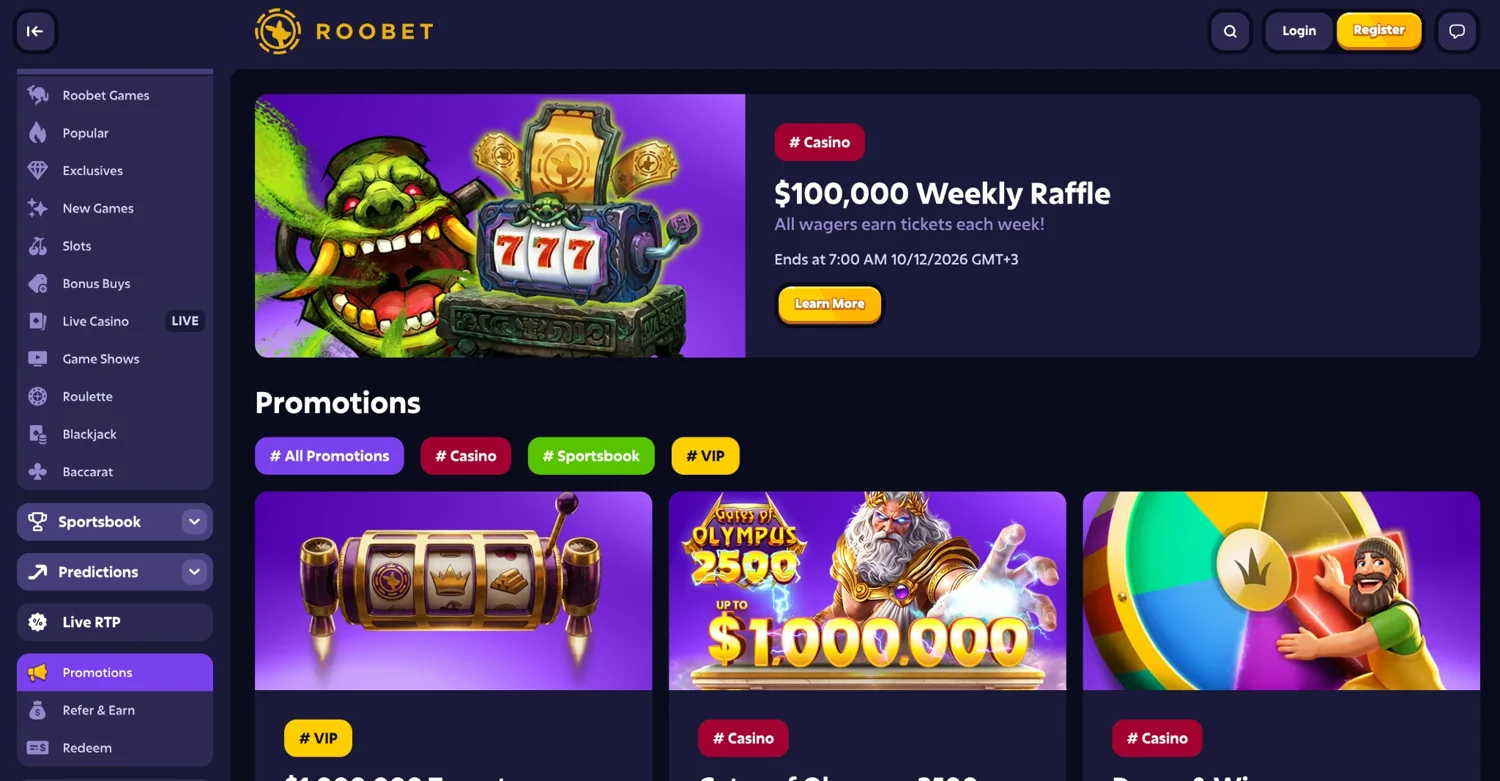
The promotions screen has several types of offers and campaign tiles. Before I include one in a comparison, I read that offer by itself. I want to know which part of the account tracks progress and which game activity it refers to. For a quick run on the house board I leave the promotions tab as a separate reference and stick with the original game budget in my example.
I use a new line for the offer amount if I am comparing it with cash funds. In a sample with a $10 cash balance and a separate promotion, I only include returns in the game line once I can identify the balance they belong to. I would then read the deposit wagering rule separately. Two progress figures beside one another can look interchangeable at a glance.
I prefer a review that puts the withdrawal rules close to the game details. On Roobet, Fun Mode gives me a quick game read. The promotion and cashier information takes another pass. I keep that difference in mind when I rank the experience. It matters to me more if I plan a small session with an early cash-out than if I simply want to explore the board mechanics.
My Roobet verdict
For me, the strength of Roobet Plinko is the direct route to the Originals title and its Fun Mode. I can focus on the board and compare a few settings from the same page. The deposit guide also gives me specific assets to look for, which is useful when I already know the network I want to use.
The 1× deposit condition is the drawback I give the most weight. A short practice run and a short cash session can have different implications once there is money in the account. I like to see the total qualifying stake beside the intended duration of a session before I decide how these two fit. That is the detail that gives me the clearest comparison with the other casinos on the list.
If I revisit Roobet, I’d use Fun Mode first to find my way around the board. Then I’d read the deposit condition and the receiving route for the amount I’m considering. I come away with a useful game option and a clear point to check on the payment side.
What I like
- I like the direct route to the Originals title in Fun Mode.
- I can find the coin list in the deposit guide.
What I keep in mind
- I find the 1× deposit condition less convenient for a short cash session.
Frequently Asked Questions
Where do I open the Roobet game?
I go to Originals and open the dedicated Plinko listing. I use Fun Mode when I want to read the board and practise the drop sequence.
Which crypto deposits do I see in the help guide?
I look for BTC, ETH and LTC, along with USDT and USDC. I check the network attached to whichever asset I choose in the cashier.
What does the crypto deposit condition mean for my plan?
I compare the deposit amount with the total I plan to wager. Roobet describes a 1× condition before withdrawal, so a sample $20 deposit and a $4 session leave a $16 difference.
What number do I look for after an on-chain withdrawal is sent?
I look for the transaction ID. I add it to the cashier request reference so I can recognise the right entry on the receiving side.
What did I find less convenient?
I like starting with Fun Mode. I find the deposit wagering condition less convenient for a short cash session followed by an early withdrawal.