 Plinko Bitcoin
How to Play Plinko With Crypto
I walk through a sample crypto Plinko session, from reading the payout board to matching a withdrawal with the wallet record.
I start with the game title and stake unit
Before the first drop, I make a short note so I can repeat the same setup later.
Game and provider
I open the exact title in the lobby and read the help panel for the stake range.
Stake and currency
I record the unit shown in the game. For example, I write CAD $0.40 or 400 sats (0.00000400 BTC).
Board and balance
I note the row count, risk setting and whether the screen shows a practice or cash balance. A sample setup is 12 rows, Low, CAD $0.40.

How I read the payout row in a demo
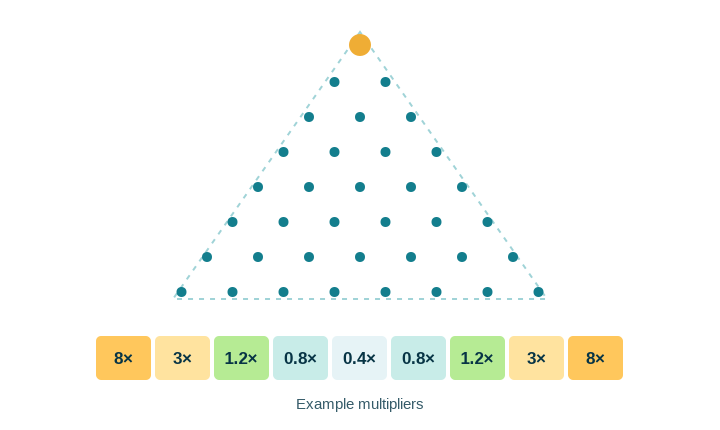
In one demo example, three CAD $0.40 drops land on 0.5×, 1× and 2×. I record $1.20 in stakes and $1.40 in returns, leaving a net gain of $0.20 before fees.
Read the net result
I subtract the stake from each return. A 1× return leaves me even for that drop.
Compare risk settings
I leave the row count steady and compare the middle and outer bins when I change risk.
| Bin | Return | Net result |
|---|---|---|
| 0.5× | $0.20 | −$0.20 |
| 1× | $0.40 | $0.00 |
| 2× | $0.80 | +$0.40 |
I check the withdrawal route before a deposit
I open both cashier tabs and make a separate note for each direction.
Withdrawal
I record the asset, network and minimum, then check which route my receiving wallet supports.
Deposit
I match the cashier’s instructions to the sending wallet. If the cashier specifies Lightning or Bitcoin mainnet, I select that same route.
Account currency
I check the unit used for my game balance and note any conversion. For a stablecoin, I write its token and network together.

What I do with a pending deposit
I follow the existing entry in the cashier’s deposit history. If two transfers look similar, the transaction ID helps me find the right one.
In the sending wallet
I save the transaction ID, amount sent, fee and time.
In the cashier
I match the transfer and note when it shows as credited.
If the cashier converts it
I record the CAD value separately. In a sample $25-equivalent deposit, this lets me distinguish the fee from the conversion.
I keep my stake and drop count steady
I use single drops for a short practice run so I can log each multiplier as it lands.
Before the run
I choose eight drops, a CAD $0.25 stake and one risk setting.
During the run
I record each multiplier. If I reopen the board or rotate my phone, I check the stake readout again.
After eight drops
I stop and total the results. A change in stake unit or board setup gets a fresh entry.
Eight-drop practice tally
- Total stake
- 8 × CAD $0.25 = $2.00
- Total returned
- $1.65
- Net change
- −$0.35
I follow a withdrawal in two records
In a sample withdrawal, I request 25,000 sats. With a 200-sat fee, I look for 24,800 sats in the receiving wallet.
Cashier reference
I save the request reference, date, fee and expected received amount. I use this record to follow the original request.
Transaction ID
Once the cashier sends the transfer, I match its ID to incoming wallet activity and record when the funds become available.
How I trace the last step in a slow transfer
I start with the exact status shown beside the amount. It tells me where to look next.
Waiting for confirmations
I check the existing transaction in my wallet and compare the network.
Still in the cashier
I look for an update on the request and keep the cashier reference handy for support.
Visible in the receiving wallet
I check the confirmation count and any minimum credit amount on the receiving deposit screen.

Frequently Asked Questions
Which number do I read before pressing Drop?
I read the stake beside the button and its unit. I also check the risk setting and row count above the board. I use that combination to label the round in my notes.
How do I compare two risk settings?
I hold the row count and example stake steady. I change only the risk setting, then look at the middle bins and outer bins together. I keep each group of practice drops on its own line.
What is the difference between the return and the net result?
The return is everything the bin pays back. I get the net result by subtracting the original stake. A $0.80 return on a $0.40 drop gives me a $0.40 gain.
When do I use the cashier reference?
I use it to check the status of the original request inside the casino. Once an on-chain transfer has a transaction ID, I use that second reference to match incoming activity.
Why do I look at both cashier tabs before funding?
I want to know which route I’ll use to send a deposit and which route I’d select to withdraw. I record each minimum beside its direction so I read the right figure when I need it.